


 PLATFORM UPDATE:

MoS2-functionalized sulfonated polystyrene for adsorption of rhodamine B

Abstract
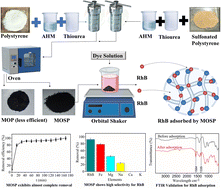
A novel MoS2-incorporated sulfonated polystyrene composite (MOSP) is developed for the selective removal of rhodamine B (RhB) from aqueous solutions. The materials are characterized using SEM-EDS, XRD, Raman spectroscopy, FTIR, CHNS elemental analysis, BET, and TGA, while UV-visible spectrophotometry and ICP-OES are employed to quantify RhB and interfering metal ions. Batch adsorption experiments are carried out to optimize pH, contact time, dye concentration, adsorbent dosage, and temperature. Kinetic studies indicate that chemisorption, described by the pseudo-second-order model, is the dominant mechanism, with rapid adsorption reaching equilibrium within one hour. Under optimal conditions, MOSP achieves a maximum adsorption capacity of 400 mg g−1 for RhB, as described by the Langmuir isotherm. Thermodynamic analysis confirmed that the process is spontaneous and exothermic. MOSP retains >90% RhB removal efficiency even in the presence of alkali, alkaline-earth, and transition metal ions. Owing to its high selectivity, facile synthesis, rapid kinetics, large capacity, cost-effectiveness, and stability, MOSP shows strong potential for commercial-scale RhB removal from wastewater.
 Please wait while we load your content...


