Issue 2, 2026

Ultra-high surface area silica material and its application for selective N-formylation using a CO2 surrogate

Abstract

A sustainable room temperature synthesis of ultra-high surface area mesoporous silica material (1653 m2 g−1), designated as QSM-2, has been developed using tetraethyl orthosilicate, cetyltrimethylammonium bromide (CTAB), and β-cyclodextrin (β-CD) as the silicon source, structure directing agent, and additive, respectively. The process was optimised by varying key reaction parameters, including the amount of additive, reaction temperature and sonication, while maintaining a constant silica-to-surfactant ratio. Scale-up studies confirmed reproducibility at a 20-gram scale, highlighting the method's potential for large scale applications. The material with an ultra-high surface area was evaluated for the N-formylation of amines using formic acid as a benign C1 source, thereby enabling the indirect utilisation of CO2. This work presents a sustainable and selective protocol for converting a wide range of amines to the corresponding formamides under mild, solvent-free conditions, achieving excellent yields (up to 99%), and high selectivity (100%).
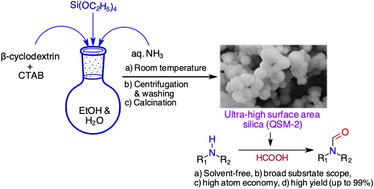
Graphical abstract: Ultra-high surface area silica material and its application for selective N-formylation using a CO2 surrogate

Supplementary files

Article information

Article type
Paper
Submitted
28 Sep 2025
Accepted
18 Dec 2025
First published
07 Jan 2026
This article is Open Access
Creative Commons BY-NC license

RSC Adv., 2026,16, 1900-1911

Ultra-high surface area silica material and its application for selective N-formylation using a CO2 surrogate

M. Anwar, S. Pathan, P. S. Reddy, J. Ponraj and S. Dastgir, RSC Adv., 2026, 16, 1900 DOI: 10.1039/D5RA07379K

This article is licensed under a Creative Commons Attribution-NonCommercial 3.0 Unported Licence. You can use material from this article in other publications, without requesting further permission from the RSC, provided that the correct acknowledgement is given and it is not used for commercial purposes.

To request permission to reproduce material from this article in a commercial publication, please go to the Copyright Clearance Center request page.

If you are an author contributing to an RSC publication, you do not need to request permission provided correct acknowledgement is given.

If you are the author of this article, you do not need to request permission to reproduce figures and diagrams provided correct acknowledgement is given. If you want to reproduce the whole article in a third-party commercial publication (excluding your thesis/dissertation for which permission is not required) please go to the Copyright Clearance Center request page.

Read more about how to correctly acknowledge RSC content.

Social activity

Spotlight

Advertisements