Issue 1, 2026, Issue in Progress

Intrinsically microporous polymer (PIM-1) enhanced degradation of heptadecafluoro-1-nonanol at graphitic carbon nitride (g-C3N4)

Abstract

The photochemical transformation of polyfluorinated alkyl substances (PFAS) leads to structural unzipping to give rise to fluoride and further degradation products depending on (i) the type of photocatalyst as well as on (ii) microporous coatings or reaction environments. Here, a substantial increase in photocatalyst performance is observed by coating graphitic carbon nitride (g-C3N4) with an intrinsically microporous polymer (PIM-1) to enhance interaction with heptadecafluoro-1-nonanol (as a PFAS model).
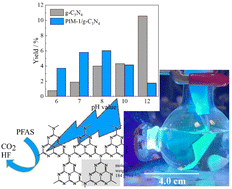
Graphical abstract: Intrinsically microporous polymer (PIM-1) enhanced degradation of heptadecafluoro-1-nonanol at graphitic carbon nitride (g-C3N4)

Supplementary files

Article information

Article type
Paper
Submitted
25 Sep 2025
Accepted
17 Dec 2025
First published
02 Jan 2026
This article is Open Access
Creative Commons BY license

RSC Adv., 2026,16, 28-33

Intrinsically microporous polymer (PIM-1) enhanced degradation of heptadecafluoro-1-nonanol at graphitic carbon nitride (g-C3N4)

F. C. O. L. Martins, W. R. Melchert, A. Karunakaran, C. R. Bowen, N. Garrod, P. J. Fletcher, M. Carta, D. Taylor, N. B. McKeown and F. Marken, RSC Adv., 2026, 16, 28 DOI: 10.1039/D5RA07284K

This article is licensed under a Creative Commons Attribution 3.0 Unported Licence. You can use material from this article in other publications without requesting further permissions from the RSC, provided that the correct acknowledgement is given.

Read more about how to correctly acknowledge RSC content.

Social activity

Spotlight

Advertisements