


 PLATFORM UPDATE:

Piperidine-catalyzed synthesis of (E)-2-cyanoacrylamides: crystallographic, antiproliferative, and docking studies

Abstract
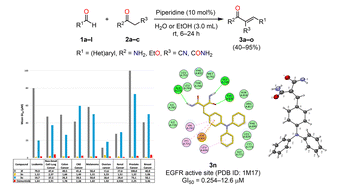
A piperidine-catalyzed Knoevenagel condensation between (hetero)aromatic aldehydes 1a–i and 2-cyanoacetamide 2a was developed to afford (E)-2-cyano-3-(het)arylacrylamides 3a–i in 40–95% yields under mild and environmentally friendly conditions. The methodology was further extended to other methylene active compounds, including malonamide 2b and ethyl cyanoacetate 2c, providing the corresponding adducts 3m–o in 54–81% yields. The (E)-stereochemistry of 3-arylacrylamide 3i was unambiguously confirmed by single-crystal X-ray diffraction analysis. The antiproliferative activity of compounds 3a–o was evaluated across the NCI-60 human cancer cell line panel. Compounds 3f and 3o exhibited the highest potency against the CAKI-1 renal cancer cell line, with GI50 values of 0.287 µM and 0.336 µM, respectively, while compound 3n showed its strongest activity against the RPMI-8226 melanoma cell line (GI50 = 0.367 µM). These values are comparable to or lower than those of the reference drug Osimertinib (GI50 = 0.343 µM for CAKI-1 and 1.95 µM for RPMI-8226 cell lines). In all active cases, LC50 to GI50 ratios equal to or greater than 100 indicated selective growth inhibition rather than nonspecific cytotoxicity. Compound 3n exhibited a slightly higher cytotoxic response compared with its structural analogues. To rationalize this behavior, toxicity profiling revealed a coordinated activation of Nrf2-mediated oxidative stress, p53-dependent DNA damage response, and androgen receptor (AR-LBD) signaling pathways. Molecular docking studies further demonstrated favorable binding interactions of compounds 3f, 3n, and 3o within the tyrosine kinase domain of the epidermal growth factor receptor (EGFR), with predicted affinities surpassing that of Erlotinib.
 Please wait while we load your content...


