


 PLATFORM UPDATE:


Synthesis of Cu-doped V2O5 thin films with improved optical and CO2 gas sensing
 a
Rana
Saad,
*b
a
Rana
Saad,
*b
Abstract
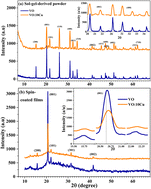
This study provides a comprehensive investigation of Cu-doped vanadium oxide (V2O5) thin films prepared via a sol–gel/spin-coating method, correlating dopant-induced structural and optical modifications with improved CO2 sensing performance at room temperature. XRD confirmed the incorporation of Cu into the V2O5 lattice without secondary phase formation, while FE-SEM revealed a morphological transition from nanoplates to nanobelts upon Cu-doping. EDX verified uniform elemental distribution, and UV-Vis measurements indicated a reduced optical band gap, consistent with enhanced charge transport. FTIR spectra exhibited characteristic V–O vibrations, along with CO2-related absorption bands, indicating favorable surface interactions. Gas sensing experiments demonstrated that Cu incorporation significantly improved sensitivity, response/recovery times, and selectivity. At 8880 ppm CO2, the 10 at% Cu-doped V2O5 films achieved a response of 40.7% with fast response (3.83 min) and recovery (3.3 min) times, excellent repeatability, and stable operation over 30 days. These findings establish 10 at% Cu-doped V2O5 thin films as a promising, low-cost material for efficient room-temperature CO2 detection.
 Please wait while we load your content...


