


 PLATFORM UPDATE:


Recent advances in enhancing the luminescence efficiency of rare earth upconversion nanoparticles for biomedical applications
 *a
*a
Abstract
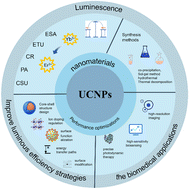
Rare earth upconversion nanoparticles (UCNPs) have made remarkable progress in overcoming the limitations of traditional optical probes in biomedical applications, such as shallow tissue penetration and strong background interference, owing to the anti-Stokes luminescence properties of near-infrared excitation followed by visible/ultraviolet emission. In this review, we systematically summarized the core luminescence mechanisms, including excited-state absorption, energy transfer upconversion, photon avalanche, and other multipath energy transfer processes, and discussed the optimization progress of the co-precipitation, sol–gel method, hydrothermal, and thermal decomposition methods. This review focused on the latest achievements in improving luminous efficiency through strategies such as core–shell structure design, ion doping regulation, and surface functionalization. In biomedicine, UCNPs have been used for the high-resolution imaging of deep tissues, high-sensitivity biosensing, and precise photodynamic therapy. Moreover, this article systematically reviewed the latest research progress on the biomedical applications of UCNPs. Finally, we proposed a development direction in material design innovation and clinical translation to provide a reference for promoting the development of UCNPs from laboratory research to practical applications.
 Please wait while we load your content...


