


 PLATFORM UPDATE:


Valorizing biomass into ultrahigh-surface-area porous carbon for sustainable next-generation energy storage

Abstract
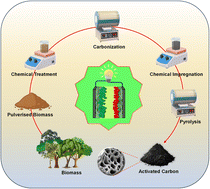
Developing biomass-derived porous carbon materials aligns with global efforts toward sustainable and environmentally friendly energy storage solutions. The renewable nature of this biomass-derived carbon material makes it well-suited for use in high-performance supercapacitor electrodes. This study employs a thermochemical activation method to synthesize ultrahigh-surface-area porous carbon from Acacia auriculiformis leaves. The synthesis process includes an initial pre-carbonization step followed by chemical activation, yielding a highly porous activated carbon with an exceptional BET surface area of 1913 m2 g−1. The electrochemical behavior of Acacia auriculiformis leaf-based activated carbon (ALC) electrodes was evaluated in a symmetric supercapacitor configuration with H2SO4 (1 M) as the electrolyte. At a current density of 0.5 A g−1, ALC electrodes achieved a specific capacitance (Csp) of 222 F g−1. The electrodes demonstrated robust cycling stability, retaining 89.3% of its initial capacitance even after 5000 cycles at a current density of 5 A g−1. This research highlights the viability of Acacia auriculiformis leaves waste as an abundant and renewable precursor for sustainable electrode materials, contributing to the advancement of eco-friendly energy storage technologies.
 Please wait while we load your content...


