


 PLATFORM UPDATE:


Self-assembled isomorphous 2D triangular networks: divergent magnetic relaxation in Co(ii) and Cu(ii)
 a
Henrique C. S.
Junior,
b
Guilherme P.
Guedes,
c
Davor L.
Mariano,
d
Angelo M.
Gomes,
d
Wallace C.
Nunes
*e
and
Maria Vanda
Marinho
*a
a
Henrique C. S.
Junior,
b
Guilherme P.
Guedes,
c
Davor L.
Mariano,
d
Angelo M.
Gomes,
d
Wallace C.
Nunes
*e
and
Maria Vanda
Marinho
*a
Abstract
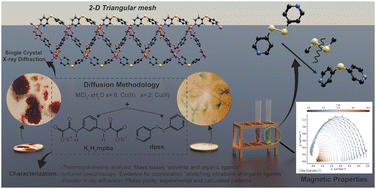
Two homonuclear coordination networks of general formula [{Co(H2mpba)(dps)}·2DMSO]n (1) and [{Cu(H2mpba)(dps)}·2DMSO·H2O]n (2) [H4mpba = 1,3-phenylenebis(oxamic) acid; dps = 4,4′-dipyridyl sulfide] were prepared by the diffusion method at room temperature, characterized, and their magnetic properties investigated. The starting 4,4′-dipyridyl disulfide (dpds) ligand undergoes complete in situ transformation into dps under mild conditions, affording the two-dimensional polymeric arrays. The H2mpba2− exhibits the bis-bidentate coordination mode, and the dps serves as a bridging ligand between two metal centers, yielding a two-dimensional coordination network with a triangular-like structure, in which the metal ions act as connecting nodes. AC measurements demonstrate that they exhibit slow magnetic relaxation in the absence of an applied DC field (1) and under an applied direct-current (DC) field (2), with a single bottleneck effect. Compound 1 shows a weak but clear out-of-phase signal at zero field, confirming a single-ion magnet (SIM) behavior. At 1 kOe, a bottleneck effect dominates below 7.5 K. At the same time, the Orbach process prevails at 7.5–11.5 K, supported by strong easy-axis anisotropy (D = −103.7(7) cm−1) (D = −106.0 cm−1 and ∣E/D∣ = 0.23 from ab initio CASSCF/NEVPT2 calculations), and significant rhombicity, yielding an effective energy barrier, Ueff = 56(3) K with a pre-exponential factor of relaxation time, τ0 = 1.2(1) × 10−8 s. Compound 2 displays field-induced slow relaxation at 1 kOe due to the bottleneck effect.
 Please wait while we load your content...


