


 PLATFORM UPDATE:

Selective detection of Cu2+ in aqueous medium using an acid hydrazide-based chemosensor: experimental and DFT/TDDFT studies
 *a
Paul G.
Waddell,
b
*a
Paul G.
Waddell,
b
Abstract
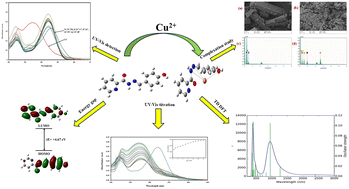
An acid hydrazide-based Schiff base, N'-(4-hydroxybenzylidene)picolinohydrazide (HP), was designed and synthesized in a single-step process for the selective detection of Cu2+ ions. The structure of HP was thoroughly characterized by FTIR, 1H NMR, 13C NMR, HRMS, SCXRD and elemental analysis. The cation-sensing performance of HP was investigated using UV-Vis spectroscopy, revealing a rapid response with high selectivity and sensitivity toward Cu2+ in MeOH/H2O (6 : 4, v/v) with a 10 mM HEPES buffer at pH 7.4, with a detection limit of 8.94 µM. Job's plot analysis confirmed a 1 : 1 binding stoichiometry, with an association constant of 4.26 × 10⁴ M−1. FESEM analysis showed distinct morphological changes upon Cu2+ coordination. The SCXRD result exhibits good agreement with DFT and TD-DFT of the probe HP. The hole–electron analysis clearly reveals locally excited (LE) characteristics for the free ligand and intramolecular charge transfer (ICT) behavior for the HP–Cu2+ complex. Furthermore, the HP probe demonstrated practical applicability for Cu2+ detection in real water samples.
 Please wait while we load your content...


