


 PLATFORM UPDATE:

Hybrid exosomes: a rising horizon for precision cancer therapy
 a
Asmit
Das,
a
Rajib
Dhar,
c
Ketki
Kalele,
d
Vinod R. M. T.
Balasubramaniam,
a
Ling Shing
Wong,
e
Vinoth
Kumarasamy
f
and
Vetriselvan
Subramaniyan
*c
a
Asmit
Das,
a
Rajib
Dhar,
c
Ketki
Kalele,
d
Vinod R. M. T.
Balasubramaniam,
a
Ling Shing
Wong,
e
Vinoth
Kumarasamy
f
and
Vetriselvan
Subramaniyan
*c
Abstract
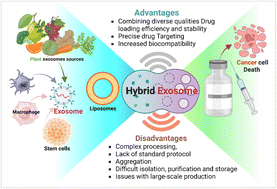
Extracellular vesicles (EVs) are nanoscale vesicles, which show significant promise as biomarkers for cancer diagnosis and prognosis, by providing valuable information about cancer progression and treatment response. Their therapeutic potential (including their popular subset: exosomes) is significant, but challenges remain. These limitations with natural exosomes, necessitate innovative engineering strategies. However, current methods for engineering exosomes, such as chimeric and surface modifications, still need to be improved. A prominent issue is drug off-targeting, leading to ineffective treatment and side effects. To address these challenges, “hybrid exosomes” have been engineered by combining the inherent biocompatibility of natural exosomes with the versatility of synthetic nanoparticles. Cutting-edge design strategies for hybrid exosomes, such as bio-hybrid approaches, emphasize their superior drug loading capacity, and targeted delivery to tumor sites, resulting in minimized toxicity profiles. Furthermore, we showcase recent breakthroughs in leveraging hybrid exosomes for the effective delivery and cellular uptake of chemotherapeutic agents and immunotherapies, which offer significantly enhanced therapeutic outcomes in preclinical cancer models, with emerging clinical relevance. This review explores the evolving field of hybrid exosomes, a novel approach to cancer therapeutics and highlights their potential to overcome existing limitations in cancer treatment. Hybrid exosomes offer a transformative approach to cancer treatment, promising affordable and effective precision therapy with a significant impact on cancer therapeutics.
- This article is part of the themed collection: 2026 Reviews in RSC Advances
 Please wait while we load your content...


