


 PLATFORM UPDATE:


In silico design and binding mechanism of UBR1 E3 ligase recruiters
 *a
Sun
Choi
*a
*a
Sun
Choi
*a
Abstract
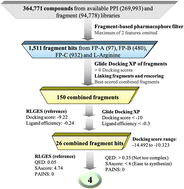
Proteolysis Targeting Chimeric Molecules (PROTACs) represent a promising avenue in drug discovery, as they can induce the targeted degradation of disease-relevant proteins within the cellular machinery. These compounds comprise a ligand tailored to bind the specific targeted protein connected to a recruiter molecule that engages with the E3 ligase. Despite their promise as therapeutic agents, the clinical advancement of these compounds has encountered substantial challenges, primarily due to the limited availability of suitable E3 ligases. Additionally, cell permeability and proteolytic stability, due to their peptide nature, often hinder their application. In this study, we developed a computational framework to model recruiters for the E3 ligase UBR1. This widely expressed protein has recently been demonstrated to be efficient in driving the degradation of oncogenic proteins. Our computational approach leverages a fragment-based peptidomimetics strategy, integrating pharmacophore filtering, docking, and fragment-linking optimization. Finally, we subjected the wild-type peptide and the most promising combined fragments to advanced binding free energy calculations, unveiling insights into their dynamic water-mediated binding mechanisms and their potential as robust E3 ligase UBR1 recruiters. This computational workflow is applicable to model other related PROTACs.
 Please wait while we load your content...


