


Crosslinked porphyrin–copper polymer catalyzed hydroboration of alkynes and alkenes
 a
Mingyou
Hu
*a
a
Mingyou
Hu
*a
Abstract
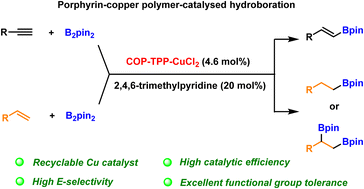
Organoboron compounds have emerged as versatile building blocks in modern synthetic chemistry, owing to the facile transformation of C–B bonds into diverse functional groups. Herein, we report the successful preparation of three porphyrin–copper crosslinked porous organic polymer catalysts through radical copolymerization, which serve as highly efficient heterogeneous catalysts for the hydroboration of alkynes and alkenes. Among them, the COP-TPP-CuCl2 catalyst exhibited exceptional catalytic activity, high stereoselectivity, broad substrate tolerance, and excellent recyclability in both alkyne and alkene hydroboration reactions. Remarkably, this catalyst enables selective modulation of alkene hydroboration outcomes based on substrate electronic properties, affording either monoborylation or diborylation products in a controlled manner. The implemented dual strategy of “atomic anchoring–spatial confinement” effectively suppresses the migration and aggregation of copper species, thereby establishing a robust heterogeneous catalytic system for sustainable organoboron ester synthesis. This innovative design addresses the persistent drawbacks of metal leaching and catalytic deactivation commonly encountered with conventional homogeneous copper catalysts during recycling.
 Please wait while we load your content...


