


 PLATFORM UPDATE:

Chirality-selected non-equilibrium self-assembled hydrogels with tunable emission for information encryption
 *a
*a
Abstract
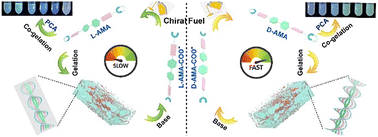
Chiroptical materials constructed via chirality-selected non-equilibrium systems of enantiomers can provide multidimensional codes through variations in emission wavelength and intensity, offering new opportunities for advanced information encryption. Herein, we realize distinct emission behaviors between enantiomers through a chirality-selected self-assembly process, enabling multidimensional information encoding involving emission wavelength, emission intensity, and chirality. The chiral non-equilibrium self-assemblies were successfully constructed by using D-(+)-glucono-1,5-lactone (GDL) as the chiral chemical fuel, which would further drive chiral amino acid derivatives (D/L-AMA) to self-assemble into hydrogels. Owing to the intrinsic chirality of GDL, D-AMA exhibits faster gelation kinetics and forms more compact stacking structures than L-AMA. Upon incorporation of 1-pyrenecarboxylic acid (PCA), a commercially available dye whose emission depends on its aggregation mode, a deeper yellow emission is observed in D-AMA hydrogels due to chirality-biased assembly processes. Moreover, this chirality-selected fluorescence behavior is successfully applied to construct information encoding and logic gate systems, where stored patterns are revealed only in the simultaneous presence of GDL and D-AMA. This chirality-selected assembly strategy, which induces differential emission behavior between enantiomers, provides multidimensional optical codes and offers a promising route toward high-level information encryption.
 Please wait while we load your content...


