


 PLATFORM UPDATE:


Computational and synthetic studies on the conversion of isothiocyanates into isocyanides: inspirations from the Corey–Winter olefination

Abstract
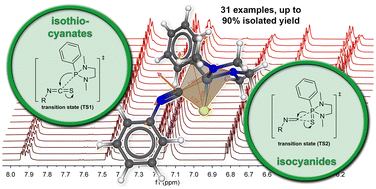
Inspired by DFT calculations on the mechanism of the Corey–Winter olefination (CWO), it seemed possible that the desulfuration of isothiocyanates using P(III)-reagents should proceed smoothly to furnish the corresponding isocyanides. A detailed theoretical study on the mechanism of the desulfuration reaction revealed similar intermediates and transition states as compared to the CWO. Here, the only intermediate results from attack of the P reagent on the thiocarbonyl group. This ylide-type structure then undergoes smooth cycloreversion to directly liberate the corresponding isocyanide. The isothiocyanate substrate scope, limitations of the P(III)-reagent, and solvent effects are evaluated computationally and compared to experimental synthetic studies. Experimentally, the functional group tolerance of the isothiocyanate desulfuration proves to be excellent, and a large variety of solvents is tolerated including solvent-free variants. The reaction is pleasing invariant to steric hinderance and proceeds under very mild conditions, rendering this method valuable especially to otherwise difficult to synthesize isocyanides. The kinetics of various desulfuration reactions was followed by NMR spectroscopy, and the scope of this reaction and its applicability to ensuing reactions with and without isolation of the isocyanides is explored.
- This article is part of the themed collection: 2026 Organic Chemistry Frontiers HOT Articles
 Please wait while we load your content...


