


 PLATFORM UPDATE:

Unraveling the mechanism and probing the origins of stereocontrol in a cobalt-catalyzed carboamination reaction
 *a
*a
Abstract
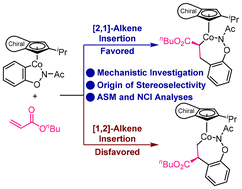
In the present study, the potential reaction mechanism for the cobalt-catalyzed carboamination of phenoxyacetamide with butyl acrylate was investigated using density functional theory (DFT) calculations. The computed energy profile indicates that the thermodynamically preferred pathway proceeds via sequential N–H deprotonation, C–H activation, [2,1]-alkene insertion, oxidative addition, reductive elimination, and final protonation of the oxygen and nitrogen atoms. By contrast, the alternative route involving [1,2]-alkene insertion is significantly higher in energy and thus less favorable. Stereochemical analysis confirms that the [2,1]-insertion mode governs the observed selectivity, leading predominantly to the S-configured isomer as the major product. Further insight from the activation strain model (ASM) and noncovalent interaction (NCI) analyses reveals that stabilizing noncovalent contacts dictate the stereoselectivity outcome.
 Please wait while we load your content...


