Enantioselective Synthesis of Allylic Boronates bearing a Stereodefined (E)-Alkenyl Chloride by Cu-Catalyzed Borylation of Allylic gem-Dichlorides

Abstract

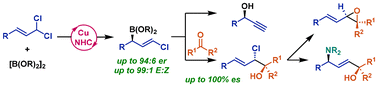
Chiral α,γ-substituted allyl boron reagents are valuable tools in organic synthesis. However, asymmetric catalytic strategies for synthesising this type of compounds bearing a stereodefined alkenyl chloride are underdeveloped. Here we report a copper-catalyzed enantioselective borylation of allylic gem-dichlorides that provides optically active allylic boronates bearing an (E)-configured alkenyl chloride with high levels of enantioselectivity and E-selectivity. These enantioenriched allyl boronates serve as versatile building blocks for different stereospecific reactions, including their conversion into chiral propargyl alcohols and the diastereoselective addition to ketones to afford enantioenriched allylic chlorohydrins. DFT calculations provide mechanistic insight, revealing key noncovalent interactions that rationalize the observed stereocontrol. This study expands the synthetic utility of allylic boronates and offers a mechanistically informed approach to asymmetric catalysis involving gem-dichloride substrates.
Supplementary files

Article information

Article type
Research Article
Submitted
16 Jan 2026
Accepted
21 Feb 2026
First published
24 Feb 2026
This article is Open Access
Creative Commons BY-NC license

Org. Chem. Front., 2026, Accepted Manuscript

Enantioselective Synthesis of Allylic Boronates bearing a Stereodefined (E)-Alkenyl Chloride by Cu-Catalyzed Borylation of Allylic gem-Dichlorides

A. Chaves-Pouso, A. M. Álvarez Constantino, P. Gomez Roibás and M. Fañanás-Mastral, Org. Chem. Front., 2026, Accepted Manuscript , DOI: 10.1039/D6QO00061D

This article is licensed under a Creative Commons Attribution-NonCommercial 3.0 Unported Licence. You can use material from this article in other publications, without requesting further permission from the RSC, provided that the correct acknowledgement is given and it is not used for commercial purposes.

To request permission to reproduce material from this article in a commercial publication, please go to the Copyright Clearance Center request page.

If you are an author contributing to an RSC publication, you do not need to request permission provided correct acknowledgement is given.

If you are the author of this article, you do not need to request permission to reproduce figures and diagrams provided correct acknowledgement is given. If you want to reproduce the whole article in a third-party commercial publication (excluding your thesis/dissertation for which permission is not required) please go to the Copyright Clearance Center request page.

Read more about how to correctly acknowledge RSC content.

Social activity

Spotlight

Advertisements