


 PLATFORM UPDATE:

Electronic modification of hexa-2,4-diyne-1,6-diols: predictive access to strained cyclobutenes and 3(2H)-furanones
 a
Diego
Cordova Mariño,
a
Ingrid Y.
Dell,
a
Elena
Dallerba,
b
Carol
Hua,
c
Paul J.
Low,
a
Massimiliano
Massi
b
and
Marcus
Korb
*a
a
Diego
Cordova Mariño,
a
Ingrid Y.
Dell,
a
Elena
Dallerba,
b
Carol
Hua,
c
Paul J.
Low,
a
Massimiliano
Massi
b
and
Marcus
Korb
*a
Abstract
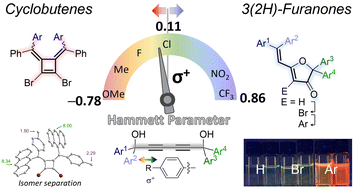
The acid-mediated activation of hexa-2,4-diyne-1,6-diols (1) is the standard protocol for the formation of valuable strained 1,2-dihalocyclobutenes/1,2-dihalobutafulvenes (3). However, the reaction is sluggish, associated with poor yields caused by formation of various unknown byproducts, and so far limited to only two examples. Herein, detailed mechanistic studies revealed the nature of the by-products with the kinetically preferred product class identified as 5-vinyl-3(2H)-furanones (4), of which only a few examples are reported. Electron-donating substrates favor sequential dehydroxylation, stabilizing discrete allenylic cations that undergo rapid halogen capture into dibromo bisallenes (2) and subsequent conrotatory electrocyclization into 1,2-dibromocyclobutenes. In contrast, electron-withdrawing substituents redirect the reaction toward selective hydration and 5-exo-dig cyclization into regio-defined 5-vinyl-3(2H)-furanones. DFT analysis, electronic-structure correlations, and single-crystal X-ray diffraction rationalize the divergent pathways and the influence of steric congestion on allene cyclization. Mechanistic studies using asymmetric diols (Ar1)2C(OH)–C![[triple bond, length as m-dash]](https://www.rsc.org/images/entities/char_e002.gif) C–CC–C(OH)(Ar2)2 (Ar1 ≠ Ar2) yielded single regio-isomeric 5-vinyl-furan-3(2H)-ones. The 3(2H)-furanones can undergo selective C4 functionalization and cross-coupling, providing fluorescent scaffolds with tunable emission across the visible spectrum increasing from 550 to 665 nm via 4-R = Br < CC-C6H4-4-OMe.
C–CC–C(OH)(Ar2)2 (Ar1 ≠ Ar2) yielded single regio-isomeric 5-vinyl-furan-3(2H)-ones. The 3(2H)-furanones can undergo selective C4 functionalization and cross-coupling, providing fluorescent scaffolds with tunable emission across the visible spectrum increasing from 550 to 665 nm via 4-R = Br < CC-C6H4-4-OMe.
 Please wait while we load your content...


