Amine-cation-driven heteroannulation of halomaleimides with C–N cleavage: metal-free access to heterobicyclic frameworks

Abstract

Maleimides and their derivatives are highly versatile scaffolds with broad applications in synthetic chemistry, medicinal chemistry, and materials science; however, methods to expand their structural diversity remain limited. Here, we present a so far undescribed, metal-free, and mild strategy for the rapid construction of functionalized maleimides from readily available dihalomaleimide derivatives. The reaction is initiated by tertiary amine-mediated formation of an ammonium cation, which directs heteroannulation to efficiently generate heterobicyclic scaffolds. This modular approach also enables the synthesis of 3,4-diamino-substituted maleimides, including challenging second halogen substitutions with weak nucleophiles. Mechanistic studies indicate that a quaternary enamine intermediate plays a central role in steering the transformation, providing broad functional group tolerance and synthetically useful yields. Overall, this strategy offers a versatile platform for accessing structurally diverse maleimides, unlocking new opportunities in bioconjugation, medicinal chemistry, and materials science.
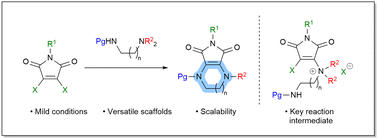
Graphical abstract: Amine-cation-driven heteroannulation of halomaleimides with C–N cleavage: metal-free access to heterobicyclic frameworks

Supplementary files

Article information

Article type
Research Article
Submitted
06 Jan 2026
Accepted
10 Feb 2026
First published
17 Feb 2026
This article is Open Access
Creative Commons BY-NC license

Org. Chem. Front., 2026, Advance Article

Amine-cation-driven heteroannulation of halomaleimides with C–N cleavage: metal-free access to heterobicyclic frameworks

L. Ciber, H. Brodnik, N. Petek, J. Svete, U. Grošelj and B. Štefane, Org. Chem. Front., 2026, Advance Article , DOI: 10.1039/D6QO00010J

This article is licensed under a Creative Commons Attribution-NonCommercial 3.0 Unported Licence. You can use material from this article in other publications, without requesting further permission from the RSC, provided that the correct acknowledgement is given and it is not used for commercial purposes.

To request permission to reproduce material from this article in a commercial publication, please go to the Copyright Clearance Center request page.

If you are an author contributing to an RSC publication, you do not need to request permission provided correct acknowledgement is given.

If you are the author of this article, you do not need to request permission to reproduce figures and diagrams provided correct acknowledgement is given. If you want to reproduce the whole article in a third-party commercial publication (excluding your thesis/dissertation for which permission is not required) please go to the Copyright Clearance Center request page.

Read more about how to correctly acknowledge RSC content.

Social activity

Spotlight

Advertisements