


 PLATFORM UPDATE:


Cu(i)-catalyzed 1,2-carbofluorination of unactivated alkenes enabled by N-fluorobenzamides via free radical relay
 *a
and
*a
and
Abstract
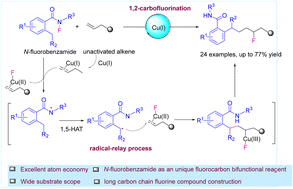
The construction of carbon–fluorine bonds has long been a challenging task. This work presents a two-component 1,2-carbofluorination bifunctionalization of unactivated alkenes via a radical-relay process. N-Fluorobenzamide was employed as a unique carbofluoro-bifunctional reagent that adds across unactivated alkenes, enabling simultaneous formation of C–C and C–F bonds. The reaction proceeds through homolytic cleavage of the N–F bond to generate a nitrogen-centered radical, followed by a 1,5-H atom transfer to produce a remote benzylic carbon radical. This carbon radical adds to the alkene, forming a new alkyl radical, which then undergoes single-electron transfer mediated by an active copper species, ultimately affording a series of β-fluoroamides in moderate yields. Notable features of this transformation include excellent atom economy (with no atom loss), mild reaction conditions and operational simplicity.
 Please wait while we load your content...


