


Synthesis of chiral rotaxanes: controlling the molecular chirality of bis-catechol spiroborate through threading

Abstract
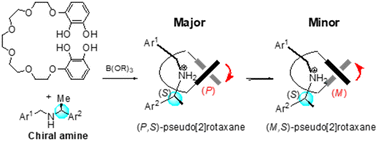
The investigation of molecular chirality within interlocked molecules is an appealing research area however, the synthesis of optically active interlocked molecules poses considerable challenges. In this study, we combined chiral spiroborate formation with the chiral recognition of secondary ammonium ions by a borate-containing crown macrocycle to synthesise optically active pseudo[2]rotaxanes from an achiral bis-catechol, chiral amines and boric acid. We examined how the chiral centres in amines influence the stereoselectivity of pseudo[2]rotaxanes under kinetic and thermodynamic conditions. Because the reversible borate-forming reaction creates a dynamic covalent bond between B and O, it facilitates the stereoselective formation of optically active pseudo[2]rotaxanes, achieving a diastereoselectivity of up to 40 : 1. After isolating the pseudo[2]rotaxanes, X-ray crystallography, circular dichroism spectroscopy and density functional theory calculations were used to reveal their absolute configuration.
 Please wait while we load your content...


