


 PLATFORM UPDATE:


Precision synthesis of peptide chimeras through site-specific azomethine ylide–dehydroalanine cycloaddition

Abstract
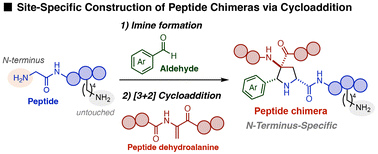
Site-selective connection of peptides is crucial for constructing structurally uniform peptide chimeras bearing multiple functions, for applications such as drug discovery and drug delivery. However, the site-specific connection of two peptides is challenging due to the need to pinpoint two reaction sites among the multiple nucleophilic sites, such as lysine ε-amines. In this work, we developed a peptide–peptide coupling method involving an Ag-catalyzed N-terminus/dehydroalanine (Dha)-selective 1,3-dipolar cycloaddition reaction, yielding peptide chimeras with exclusive endo diastereoselectivity. The use of (S)- and (R)-DTBM-SEGPHOS as chiral ligands enables control over the stereochemistry of the pyrrolidine ring, irrespective of the inherent stereochemistry of the peptides, demonstrating its utility for the late-stage installation of cyclic chiral α,α-disubstituted amino acid residues into peptides. The versatility of this method was further demonstrated through the selective generation of a Dha moiety from various amino acid residues, followed by [3 + 2] cycloaddition. Notably, generation of the N-terminal imine, exposure of the Dha residue, and [3 + 2] cycloaddition can be performed in a convergent manner using two distinct peptides and an aldehyde, without isolating each intermediate, enabling their expedient assembly into a chemically robust pyrrolidine ring.
- This article is part of the themed collection: FOCUS: Cycloaddition Chemistry
 Please wait while we load your content...


