


 PLATFORM UPDATE:


Theoretical insights into the Cu-catalyzed boronation of conjugated trienes: mechanism and selectivity control

Abstract
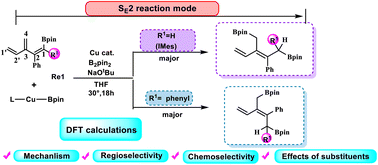
The copper-catalyzed boronation of conjugated trienes offers a promising route to organoboron compounds but is often limited by selectivity challenges. While previous studies have demonstrated its potential, a detailed mechanistic understanding of regioselectivity and stereoselectivity has been lacking. In this study, we present a comprehensive density functional theory (DFT) investigation that clarifies the reaction mechanism and the key factors influencing selectivity. Our calculations reveal a unified catalytic cycle involving η2-coordination of the copper-boryl catalyst, migratory insertion, 1,3-copper migration, and methanol-assisted protonation. The 3,4-insertion step is found to be kinetically favored, with final product selectivity determined in the later stages of the reaction. Regioselectivity is governed by electronic effects during protonation, while stereoselectivity is driven by non-covalent interactions during 1,3-copper migration. Subtle modifications, such as adding an aryl group adjacent to the boron, can reverse stereoselectivity by altering these interactions. Ligand choice also plays a critical role: bulkier N-heterocyclic carbene (NHC) ligands stabilize transition states, enhancing selectivity, while triphenylphosphine (PPh3) ligands lead to multiple competing pathways. Additionally, the pre-existing boron group actively regulates regioselectivity by stabilizing intermediate states, favoring 1,4-regioselectivity. These insights provide a framework for designing catalytic systems that enable selective functionalization of polyunsaturated substrates.
 Please wait while we load your content...


