


 PLATFORM UPDATE:

Class-II-aldolase-mimicking polyfunctional Lewis acid/azolium–aryloxide catalysts in direct enantioselective nitro-aldol additions

Abstract
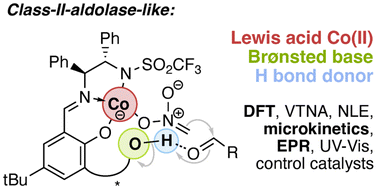
The catalytic asymmetric nitroaldol reaction is a powerful tool for accessing chiral 1,2-difunctionalized motifs, and numerous catalytic systems have been reported. Despite considerable progress in achieving high levels of stereocontrol, key challenges persist. In particular, optimal selectivity often requires cryogenic conditions, resulting in prolonged reaction times and limited practicality. In this article, a novel concept for asymmetric nitroaldol additions is introduced through a polyfunctional catalyst. This system integrates a Lewis acid, Co(II), with an azolium–aryloxide betaine, and exhibits mechanistic features reminiscent of class-II aldolases. The proposed mode of action is supported by comprehensive DFT calculations, microkinetic simulations, and detailed spectroscopic analyses. By the unique synergistic interplay of the Lewis acidic metal center, the aryloxide as Brønsted base and the corresponding aromatic alcohol serving as both hydrogen bond donor and Brønsted acid, high stereoselectivity was accomplished even at slightly elevated temperature for MeNO2. Like in class-II-aldolases, the aldehyde is activated by H-bonding to the aromatic alcohol and not by the Lewis acid. The latter serves to stabilize and direct the nitronate. The computational studies further demonstrate that the catalyst‘s key functional groups precisely orchestrate all accompanying transformations. As a result of the mild reaction conditions, not necessitating the use of an external base, the method also proved to be applicable to readily enolizable aliphatic aldehydes, such as phenylacetaldehyde.
 Please wait while we load your content...


