


Copper-catalyzed stereo- and regio-selective decarbonylative alkylation and sequential amination of alkynes with aldehydes and amides

Abstract
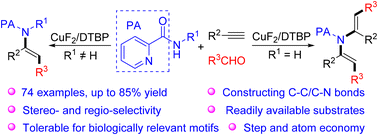
The radical difunctionalization of alkynes has been continuously explored and various molecules with specific configurations have been derived. However, the alkyl radicals discussed in these reactions are usually electron-deficient fluorinated radicals. Meanwhile, transformations involving the decarbonylation of aldehydes and addition of alkyl radicals to alkynes can only achieve the construction of C–C bonds or C–C/C–C bonds. We herein report a copper-catalyzed radical 1,2-alkylamidation of alkynes with aldehydes and amides by the establishment of C–C/C–N bonds. This protocol combines the addition of alkyl radicals to C–C triple bonds with copper chelate-assisted functionalization of vinyl radicals. Dozens of alkylated enamides, including those with biologically relevant motifs, were obtained in 27–85% yields with stubborn anti-stereoselectivity and β-regioselectivity. In addition, multi-dimensional mechanistic explorations and synthetic transformations were executed to explore the reaction details and potential applications of this protocol.
 Please wait while we load your content...


