


 PLATFORM UPDATE:


Customization of cloud temperature in amphiphilic π-systems by photoisomerization and supramolecular co-assembly for smart window applications

Abstract
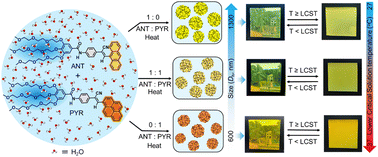
Controlling the phase transition temperature of amphiphilic polymers and small molecular systems exhibiting the lower critical solution temperature (LCST) phenomenon is crucial to regulate the transmittance of light, required for the construction of thermoresponsive smart windows. To address this problem, we have taken advantage of photoisomerization and supramolecular co-assembly of two photoresponsive amphiphilic molecules, an anthracene-derived cyanostilbene (ANT) and a pyrene-derived cyanostilbene (PYR), exhibiting different LCST phase transitions at 27 and 37 °C, respectively. Initially, aqueous solutions (1 mM) of these molecules, when heated above their LCST under ambient light, exhibited a 90% reduction in solar light transmittance owing to the increase in particle size from 10–20 nm to 0.6–1.3 µM. Subsequently, the phase transition cloud temperatures (Tcloud) could be customized by photoisomerization and co-assembly of the two molecules at different molar ratios. This approach allowed control of the particle size between 675 and 1300 nm during the LCST phase change, enabling the fine-tuning of Tcloud between 27 and 37 °C. Smart windows fabricated with ANT and PYR and their 1 : 1 combination exhibited solar and luminous transmittance reduction from 81% and 84% to 1.7% and 1.6%, respectively, at 27 °C. Thermal IR transmittance was drastically reduced from 78% to 1.8%. This approach has been used to design several custom-made smart window prototypes with controlled transparency modulation suitable for tropical climates.
 Please wait while we load your content...


