


 PLATFORM UPDATE:


Cocoon-inspired gradient mullite nanofibrous aerogels for broadband sound absorption and thermal insulation
 *d
*d
Abstract
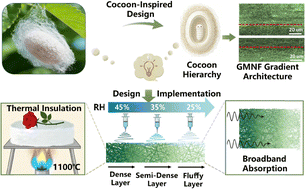
The coupled acoustic-thermal loads in high-temperature power systems pose significant risks to both personnel and equipment, demanding protective materials with combined broadband sound absorption and thermal insulation. Inspired by the hierarchical layered structure of silkworm cocoons for protecting the pupa, gradient mullite nanofibrous aerogels were fabricated through humidity-controlled electrospinning, in which a programmed decrease in ambient humidity enabled the gradual evolution of the fibrous pore structure. As the humidity decreased, the bulk density decreased from 19.2 to 6.4 mg cm−3, while the mean pore diameter increased from 2.89 to 7.24 µm. Benefiting from this gradient pore architecture, the material exhibited an α value greater than 0.8 within the 0.8 to 6 kHz frequency range, with an average α and NRC reaching 0.86 and 0.61, respectively. At room temperature, its thermal conductivity was measured to be as low as 0.024 W m−1 K−1, and it exhibited excellent stability under both high-temperature and cryogenic conditions. These results demonstrate that humidity-controlled electrospinning provides an effective and scalable route for constructing gradient ceramic fibrous materials for high-temperature acoustic-thermal protection.
- This article is part of the themed collection: Bioinspired material chemistry frontiers
 Please wait while we load your content...


