


 PLATFORM UPDATE:


Single-molecule-like intramolecular charge transfer in a multi-nitrogen hybridization HOF for selective water detection

Abstract
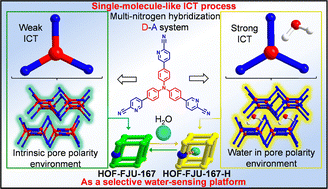
Luminescent organic crystals have attracted significant attention due to their potential in sensing and anti-counterfeiting, yet organic molecules frequently adopt a strong aggregation tendency with dense stacking and short intermolecular distances, leading to a barrier for the dynamic signal output of a single molecule. Herein, we report a single-molecule-like dynamic emission from a low-aggregated hydrogen-bonded organic framework (HOF) system via a multi-nitrogen hybridization strategy. A HOF with a donor–acceptor structure was designed via hybridizing the nitrogen atoms into both the aromatic backbone and the hydrogen-bond acceptor. The designed HOF permits the exposure of nitrogen-based recognition sites in channels, which easily triggers the charge interactions with external solvent molecules, especially water molecules, resulting in a polarity-regulated intramolecular charge transfer (ICT) process, akin to that of a single building block. On this basis, this HOF system exhibits highly selective water-responsive emission behavior, displaying a distinctive yellow emission, which can effectively identify trace water in the air, accompanied by a red shift from about 520 nm to 560 nm, further serving as a humidity-controlled anti-counterfeiting platform. These results present a promising strategy for constructing dynamic single-molecule-like emission systems tailored for highly efficient anti-counterfeiting.
 Please wait while we load your content...


