


 PLATFORM UPDATE:


Interfacing chemistry and materials for heavy metal ion sensing: mechanistic foundations and adaptive design strategies
 *b
*b
Abstract
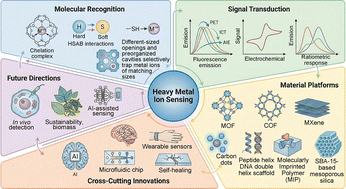
The selective and sensitive detection of heavy metal ions remains a grand challenge at the interface of materials chemistry, environmental monitoring, and public health. This review adopts a mechanism-centric perspective to deconstruct how molecular recognition principles—rooted in coordination chemistry, supramolecular interactions, and confinement effects—govern sensor performance. Rather than compiling materials by category, we critically examine structure–mechanism–performance relationships across emerging platforms including metal–organic frameworks, covalent organic frameworks, quantum dots, MXenes, molecularly imprinted polymers, biomolecular scaffolds, and functionalized mesoporous materials over the past five years. We further compare how these platforms balance sensitivity, selectivity, reversibility, interfacial transport, and practical deployability under chemically complex conditions. Special emphasis is placed on the interplay between thermodynamic affinity, kinetic reversibility, and transduction efficiency in realistic sample matrices. Beyond analytical performance, this review also discusses how interfacial design influences anti-interference capability, regenerability, and the integration of sensing with adsorptive capture in environmentally relevant systems. We highlight conceptual innovations such as multi-modal sensing, self-healing and regenerable interfaces, wearable and microfluidic integration, and machine learning-assisted selectivity enhancement. Persistent challenges—matrix effects, reproducibility gaps, and operational stability—are examined alongside strategies to bridge lab-scale sensing and field deployment. By consolidating these insights, this review provides not only a critical assessment of recent advances, but also a practical framework for identifying the key materials and mechanistic descriptors that govern translation from proof-of-concept sensing to robust real-world monitoring. This review concludes with a forward-looking framework for the rational design of intelligent sensing architectures capable of adapting to evolving environmental complexities.
- This article is part of the themed collection: 2026 Materials Chemistry Frontiers Review-type Articles
 Please wait while we load your content...


