


 PLATFORM UPDATE:


Interlayer acid-engineered 3D graphene oxide membranes with efficient proton transport and enhanced fuel cell performance

Abstract
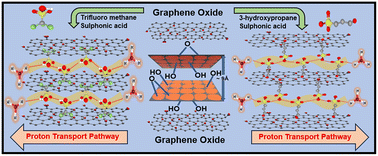
Three-dimensional graphene oxide (3DGO) hybrid membranes intercalated with trifluoromethanesulfonic acid (TFMSA) and 3-hydroxy propane sulfonic acid (HPSA) were developed to overcome the intrinsic limitations of out-of-plane proton transport in layered GO systems. The fluorinated and hydroxy sulfonic acid molecules act as non-covalent intercalators, expanding the interlayer spacing and forming continuous hydrogen-bonded networks that facilitate rapid proton hopping. The resulting 3DGO-TFMSA hybrid exhibits a markedly improved proton conductivity of 1.8 × 10⁻¹ S cm−1 at 65 °C and 90% RH, nearly two orders of magnitude higher than pristine 3DGO (5.1 × 10⁻³ S cm−1). In addition, 3DGO-HPSA shows a more than ten times higher proton conductivity of 5.4 × 10⁻² S cm−1 under the same conditions. Structural and spectroscopic analyses (PXRD, FTIR, Raman, TGA, and SEM) confirm the successful intercalation and enhanced water adsorption, while fuel-cell tests demonstrate a peak power density of 226.7 mW cm−2 and 179.2 mW cm−2 for 3DGO-TFMSA and 3DGO-HPSA membranes, respectively. The lower activation energy of 3DGO-TFMSA (0.30 eV) and 3DGO-HPSA (0.19 eV) supports the dominance of the Grotthuss mechanism through hydrogen-bond-mediated channels. This interlayer engineering strategy using fluorinated acids or hydroxy sulfonic acids provides a general, scalable route for constructing high-performance, humidity-tolerant proton exchange membranes for next-generation fuel cell technologies.
 Please wait while we load your content...


