


 PLATFORM UPDATE:


From lab to tap: 2D material innovations in detection and elimination of waterborne pathogens
 c
Jai
Prakash
*a
c
Jai
Prakash
*a
Abstract
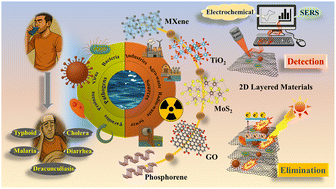
Clean water is essential for life, yet contamination by pathogens and chemical pollutants continues to threaten both public health and the environment. To tackle this challenge, researchers are turning to advanced technologies that can both detect and remove waterborne pathogens such as viruses, bacteria, and fungi. Among these, two-dimensional (2D) nanomaterials, including graphene-based and phosphorus-based materials, transition metal dichalcogenides, MXenes, 2D metal oxides etc. have shown remarkable potential. Their unique features, including large surface area, adaptable electronic properties, and strong mechanical and chemical stability, make them highly effective for water treatment. This review focuses on the emerging role of 2D nanomaterials in the detection and elimination of waterborne pathogens. For pathogen sensing, we discuss advanced detection platforms based on surface-enhanced Raman scattering (SERS) and electrochemical sensing, highlighting how the distinctive electronic and plasmonic properties of 2D materials can significantly enhance signal sensitivity, selectivity, and detection limits. In addition to sensing, the review explores strategies for pathogen removal using 2D nanomaterials, with particular emphasis on adsorptive and photo removal approaches. Adsorptive removal relies on strong surface interactions between pathogens and functional groups present on the nanomaterials, while photo removal strategies utilize the photocatalytic activity of certain 2D materials to generate reactive species capable of inactivating or degrading microorganisms. Finally, we highlight key gaps and future directions, aiming to guide the development of next-generation 2D nanomaterial-based technologies for safe and sustainable water purification.
- This article is part of the themed collection: 2026 Materials Chemistry Frontiers Review-type Articles
 Please wait while we load your content...


