


Orange-red RTP co-crystals with acid/base-triggered responsive phosphorescence

Abstract
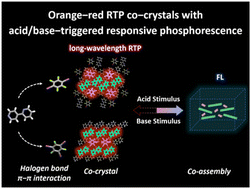
In recent years, co-crystallization has emerged as an effective approach to designing room-temperature phosphorescent (RTP) materials. However, achieving long-wavelength-emissive RTP remains challenging, due to the non-radiative deactivation, which arises from the inherently small energy gap between the lowest excited triplet state (T1) and the ground state (S0). In this study, we constructed two orange-red RTP co-crystals based on 2,4′-bipyridine (24BD) and 1,4-diiodotetrafluorobenzene (DITF) or 1,3,5-trifluoro-2,4,6-triiodobenzene (TITF). The co-crystals exhibit distinct phosphorescence properties with main emission peaks at 570 nm, with lifetimes of 32.69 ms and 22.10 ms, respectively. Crystal structure analysis and theoretical calculations indicated that tight π–π stacking and abundant intermolecular interactions within the co-crystals are responsible for the long-wavelength RTP. Interestingly, the two co-crystals exhibit distinct acid–base stimulus-responsive properties. The phosphorescence of the 24BD-DITF crystals was quenched after acid fumigation, but recovered after subsequent alkali fumigation, owing to the cleavage and reformation of halogen bonds. In contrast, the phosphorescence of the 24BD-TITF co-crystal was quenched by acid treatment and could not be restored by alkali fumigation due to its weak halogen bond, instead showing orange fluorescence. This study introduces a new material system for achieving long-wavelength RTP in organic co-crystals, and provides a foundation for developing acid–base stimulus-responsive materials for future applications.
- This article is part of the themed collection: Room-temperature phosphorescence
 Please wait while we load your content...


