


 PLATFORM UPDATE:


Rational design of phenanthroimidazole–diarylsulfone derivatives as efficient blue hot exciton emitters with hybridized local and charge transfer states

Abstract
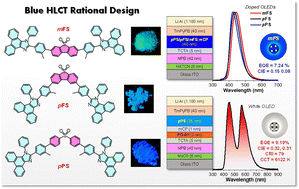
Efficient blue electroluminescent (EL) materials have been a continuing research topic for high-performance organic light-emitting diodes (OLEDs), particularly the blue emitters with the ability to utilize triplet excitons in their EL process. Herein, three donor–acceptor–donor (D–A–D) type blue fluorophores (mFS, pFS, and pPS) are systematically designed and synthesized by using diarylsulfones as acceptor cores (A) and the 1-phenyl-2-(m-tolyl)-phenanthroimidazole moiety as a π-conjugated donor (D). Different diarylsulfones (dibenzothiophene-5,5-dioxide (FS) and sulfonyldibenzene (PS)) are wisely functionalized with two donors at either meta- or para-positions. The photophysical studies and theoretical calculations verify that mFS, pFS, and pPS are blue hot exciton fluorophores with hybridized local and charge transfer (HLCT) states and decent photoluminescence quantum yields. They are effectively employed as non-doped and doped emitters in blue OLEDs with reasonable device EL performances. In particular, the doped mFS-OLED realized a deep blue emission (ELmax = 443 nm, CIE coordinates of (0.154, 0.088)) with a maximum external quantum efficiency (EQEmax) of 7.24%. Thereafter, a 2-stack white OLED is successfully fabricated using pPS as a sky-blue HLCT emitter and bis(4-phenylthieno[3,2-c]pyridinato-N,C2′)(acetylacetonate)iridium(III) (PO-01) as a complementary orange-yellow phosphorescent emitter. The white OLED achieves an EQEmax of 9.19% with CIE coordinates of (0.32, 0.31), a color-rendering index (CRI) of 79, and a correlated color temperature (CCT) of 6122 K. These results demonstrate the great potential of phenanthroimidazole–diarylsulfone-based fluorophores in developing blue organic multifunctional fluorescent materials and their OLED applications.
 Please wait while we load your content...


