


 PLATFORM UPDATE:


Synthesis, characterization, and electrochemical, optical and magnetic properties of new members of the Li2M2W2O9 (M = Mn, Fe, Co) family
 abc
Zhu
Zhang,
de
Simon
Redor,
abc
Clément
Morel,
abc
Artem M.
Abakumov,
g
Maxim
Avdeev,
jk
Jean-François
Lemineur,
d
Frédéric
Kanoufi,
d
Jean-Marie
Tarascon
*ab
and
Gwenaëlle
Rousse
*abc
abc
Zhu
Zhang,
de
Simon
Redor,
abc
Clément
Morel,
abc
Artem M.
Abakumov,
g
Maxim
Avdeev,
jk
Jean-François
Lemineur,
d
Frédéric
Kanoufi,
d
Jean-Marie
Tarascon
*ab
and
Gwenaëlle
Rousse
*abc
Abstract
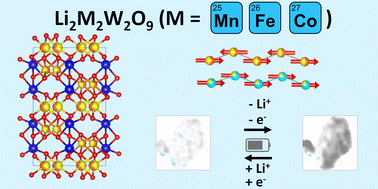
The relentless quest for new electrode materials for energy storage and electrochromic devices remains essential to improve current technology. Building on our previous discovery of Li2Ni2W2O9, a corundum-like compound with reversible Li+ intercalation and electrochromic behavior, we report three new phases – Li2Mn2W2O9, Li2Fe2W2O9 and Li2Co2W2O9 – synthesized via ceramic and carbothermal reduction methods. The three phases crystallize in either the orthorhombic Pbcn or the trigonal P![[3 with combining macron]](https://www.rsc.org/images/entities/char_0033_0304.gif) c1 space groups and feature cationic mixing between the 3d-transition metal (Mn, Fe or Co) and Li at varying levels. These materials were characterized to investigate their unique structural features, electrochemical behavior, optical response and magnetic properties. Operando optical reflection microscopy revealed distinct light-matter interactions: Li2Fe2W2O9 and Li2Mn2W2O9 showed contrast changes due to volume change during Li+ (de)intercalation, while Li2Co2W2O9 exhibited dual optical responses dominated by either light absorption or volume change. This approach enabled us to probe and comparatively rank electrochromic efficiency across the series as: Li2Ni2W2O9 > Li2Co2W2O9 > Li2Mn2W2O9 ≫ Li2Fe2W2O9. Magnetic characterization uncovers long-range antiferromagnetic ordering in both Li2Fe2W2O9 and Li2Co2W2O9, with magnetic structures proposed in the Pbc′n and refined in the Pb′c′n Shubnikov space groups, respectively. This comprehensive study reveals how transition-metal chemistry governs the interplay between electrochemical, optical, and magnetic properties in the Li2M2W2O9 family, offering a tunable platform for future multifunctional energy materials.
c1 space groups and feature cationic mixing between the 3d-transition metal (Mn, Fe or Co) and Li at varying levels. These materials were characterized to investigate their unique structural features, electrochemical behavior, optical response and magnetic properties. Operando optical reflection microscopy revealed distinct light-matter interactions: Li2Fe2W2O9 and Li2Mn2W2O9 showed contrast changes due to volume change during Li+ (de)intercalation, while Li2Co2W2O9 exhibited dual optical responses dominated by either light absorption or volume change. This approach enabled us to probe and comparatively rank electrochromic efficiency across the series as: Li2Ni2W2O9 > Li2Co2W2O9 > Li2Mn2W2O9 ≫ Li2Fe2W2O9. Magnetic characterization uncovers long-range antiferromagnetic ordering in both Li2Fe2W2O9 and Li2Co2W2O9, with magnetic structures proposed in the Pbc′n and refined in the Pb′c′n Shubnikov space groups, respectively. This comprehensive study reveals how transition-metal chemistry governs the interplay between electrochemical, optical, and magnetic properties in the Li2M2W2O9 family, offering a tunable platform for future multifunctional energy materials.
 Please wait while we load your content...


