


 PLATFORM UPDATE:


3D printed water-stable Cd-doped Cs4MnBi2Cl12/polylactic acid perovskite/polymer composites for high-flux X-ray scintillation

Abstract
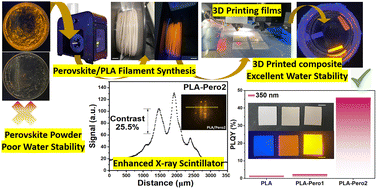
Stable and efficient X-ray scintillators are crucial for medical diagnostics, industrial, and defense applications. However, conventional scintillator technologies face a trade-off between stability, optimal performance, and sustainability. Herein, we introduce 3D-printed Cs4MnBi2Cl12 (Pero1) and Cs4Cd0.68Mn0.32Bi2Cl12 (Pero2) perovskite microcrystals embedded within a polylactic acid (PLA) polymer composite as X-ray scintillators, combining efficiency, stability, and sustainability. The orange luminescent perovskite powder phosphors exhibited poor water stability, which was successfully addressed through incorporation into PLA via filament extrusion and fused deposition modeling (FDM) 3D printing. The resulting composite films demonstrated remarkable water stability while maintaining uniform orange emission throughout the polymer matrix, as confirmed by 3D topography scanning and X-ray fluorescence mapping. Structural characterization revealed minimal chemical interaction between the perovskite and PLA matrix, with the composites retaining their crystalline properties. The PLA-Pero2 composite exhibited superior optical properties, with a photoluminescence quantum yield of 47%, nearly 17 times higher than that of PLA-Pero1 (2.8%), attributed to the effective suppression of non-radiative decay pathways through Cd2+ doping. Under hard X-ray irradiation at synchrotron beamlines, both composites exhibited excellent radioluminescence, with emission peaks at 605 nm, a linear response across a wide X-ray flux range, and remarkable radiation stability, showing less than 3% intensity degradation after 600 seconds of continuous high-dose exposure. The PLA-Pero2 composite achieved a spatial resolution of 5 line pairs per millimeter and a contrast ratio of 0.255. These performance metrics, combined with the polymer's biodegradability and scalability through additive manufacturing, position PLA-based composites as a more sustainable alternative to conventional petroleum-based polymer scintillators for next-generation medical imaging, radiation monitoring, and industrial radiography applications.
- This article is part of the themed collection: FOCUS: Perovskite Materials and Devices
 Please wait while we load your content...


