


 PLATFORM UPDATE:


Photoinduced electron transfer-driven emission enhancement in solid-state viologen hybrids
 *a
Trang Thuy
Nguyen,
c
Shuzhou
Li,
d
Jinghua
Teng,
g
Nripan
Mathews
d
and
Zexiang
Shen
*abe
*a
Trang Thuy
Nguyen,
c
Shuzhou
Li,
d
Jinghua
Teng,
g
Nripan
Mathews
d
and
Zexiang
Shen
*abe
Abstract
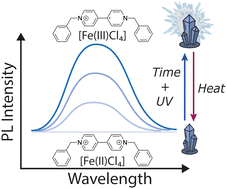
Viologens (1,1′-disubstituted-4,4′-bipyridinium salts) are well-known redox-active molecules with broad applications in energy conversion and optoelectronics. However, their excited-state dynamics in the solid state remain largely unexplored. Here, we report fluorescence enhancement in crystalline viologen-based organic–inorganic hybrids under continuous photoirradiation, where photoluminescence (PL) intensity increases up to sixfold relative to the initial emission within seconds of excitation. Spectroscopic studies, X-ray crystallography, and DFT calculations reveal that the phenomenon is driven by photoinduced electron transfer (PIET) from anionic donors to viologen dications, generating long-lived radicals. The radicals are confirmed via Raman and X-ray photoelectron spectroscopies and quenched by heating, which accelerates their consumption. Re-irradiation restores the PL, indicating reversibility. This PIET-driven PL enhancement is tunable by structural modification and stable across a range of temperatures and environments. The reversible optical response enables potential applications in optical memory and data storage.
 Please wait while we load your content...


