


 PLATFORM UPDATE:


Room-temperature phosphorescence based on doping systems: material design, mechanisms, and applications
 ab
Jibin
Song
*c
ab
Jibin
Song
*c
Abstract
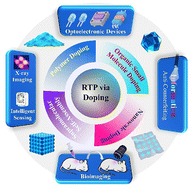
Room-temperature phosphorescence (RTP) materials have received widespread attention in the fields of optoelectronics and biomedical sciences due to their extremely long phosphorescence lifetimes and unique time-resolved properties. This review systematically evaluated the intrinsic mechanisms of doping strategies in small molecule host–guest systems, polymer matrices, supramolecular self-assemblies, and nanoscale doping systems and deeply explored the structure–activity relationship between different doping structures and properties. A detailed analysis was conducted on the mechanism by which the host–guest doping system suppresses non-radiative decay through the rigid microenvironment of the matrix and promotes singlet–triplet intersystem crossing (ISC) through the regulation of guest molecules, thereby extending the lifetime of triplet excitons. Finally, the application scenarios of RTP materials were summarized. For example, researchers have developed organic phosphorescent nanoscintillators by introducing heavy atom effects, achieving low radiation doses and high-resolution X-ray imaging in deep tumor photodynamic therapy. This provides a new idea for using phosphorescent scintillators for optical deep tissue therapy. The future development direction of RTP materials was discussed, and performance evaluation standards and strategic design ideas for doped phosphorescent materials were proposed, providing theoretical support for continuous innovation in this field.
- This article is part of the themed collections: Room-temperature phosphorescence, 2025 Materials Chemistry Frontiers Review-type Articles and 2025 Materials Chemistry Frontiers HOT Articles
 Please wait while we load your content...


