


 PLATFORM UPDATE:


Cytotoxicity and immunogenic cell death studies of water-soluble tetrahedral Ga(iii) or Fe(iii) coordination cages containing a Au(i) anticancer drug as guest
 *bcdef
and
Janet R.
Morrow
*a
*bcdef
and
Janet R.
Morrow
*a
Abstract
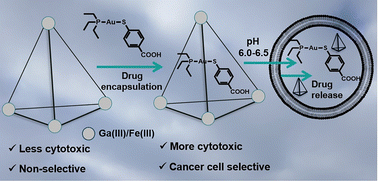
Water-soluble tetrahedral coordination cages of Ga(III) (1) or Fe(III) (2) were studied as carriers for FIN and FIN-ester as gold drugs (FIN = triethylphosphine Au(I) complex of 4-mercaptobenzoate or ethyl ester) in solution and in cell culture. Au(I) complexes remained encapsulated inside 1 or 2 at neutral pH even in the presence of serum proteins but were released at mildly acidic pH values (<6.5). The cytotoxicity response of 1 or 2 containing encapsulated FIN was assessed in two different cancer cell lines (human clear cell renal cell carcinoma ccRCC Caki-1 and murine colon carcinoma CT26) as well as normal cells (human fetal lung fibroblasts IMR-90) over a pH range of 7.5–6.2 and compared to the cages alone or gold drug alone. Free gold(I) complexes were the most highly cytotoxic but showed little selectivity for cancer cells compared to normal cells. FIN encapsulated in either Ga(III) or Fe(III) cages displayed a more selective cytotoxic response in cancer cell lines compared to normal cells. At mildly acidic pH, Fe-FIN (2a) gave IC50 values of 4 µM in CT26 cells compared to 61 µM in IMR-90 cells. Immunogenic cell death studies of FIN in Caki-1 show significant release of DAMPs ATP and HGMB1 and elicitation of prominent CRT translocation at pH 7.2. Under mildly acidic conditions (pH 6.5) there is a significant decrease in DAMPs release, and no translocation of CRT. FIN encapsulated in 1 displays translocation of CRT under these conditions underscoring the potential of water-soluble cages to transport and stabilize gold drugs.
- This article is part of the themed collection: 2026 Inorganic Chemistry Frontiers HOT Articles
 Please wait while we load your content...


