


 PLATFORM UPDATE:


First tetrametallic 19-nuclear CeIII–ScIII–WVI–SbIII cluster-incorporated polyoxometalate for electrochemical biosensing of CYFRA21-1
 *a
*a
Abstract
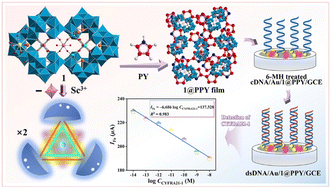
Early detection of lung cancer is pivotal for enhancing patient survival rates, wherein cytokeratin fragment antigen 21-1 (CYFRA21-1) serves as a pivotal serum biomarker for clinical diagnosis. Nevertheless, early and precise diagnosis remains severely hindered by insidious early-stage symptoms and inherent limitations of conventional detection methodologies. Herein, we report the first tetrametallic 19-nuclear CeIII–ScIII–WVI–SbIII cluster-incorporated polyoxometalate (POM), [H2N(CH3)2]10Na4H11[Ce4(H2O)24Sc5W10O26(H2O)2(SbO3)2][B-β-SbW9O33]6·80H2O (1), fabricated via a novel integrated strategy involving an “organic buffer + organic countercation + stepwise assembly”. This facile protocol enables precise control over metal ion hydrolysis and competitive coordination reactions, avoiding uncontrolled aggregation and impure phase formation during synthesis. The polyanion of 1 features a 19-nuclear [Ce2(H2O)14Sc5W10O26(H2O)2(SbO3)2]23+ cluster and two Ce3+ cations encapsulated by six [B-β-SbW9O33]9− units, representing a significant breakthrough in the rational synthesis of multi-metal high-nuclear POM clusters. Moreover, adjacent polyanions are interconnected via Ce3+ bridging nodes, constructing an innovative two-dimensional structure. Electropolymerization was employed to dope 1 into a polypyrrole (PPY) matrix, generating a uniform 1@PPY hybrid film with markedly reduced charge transfer resistance, enlarged electrochemically active surface area, enhanced electrical conductivity and long-term structural stability. Subsequently, an electrochemical biosensor based on the 1@PPY hybrid was fabricated, which realizes sensitive and quantitative detection of CYFRA21-1, accompanied by satisfactory specificity, strong anti-interference capability, good reproducibility and robust long-term stability. Additionally, the developed biosensor achieves favorable recovery rates in real human serum sample analysis, validating its practical clinical applicability. This work not only opens a new avenue for the rational design and controllable synthesis of multi-metal high-nuclear POM clusters but also provides a highly sensitive and reliable analytical platform for the early, accurate diagnosis of lung cancer in clinical settings.
- This article is part of the themed collection: 2026 Inorganic Chemistry Frontiers HOT Articles
 Please wait while we load your content...


