


 PLATFORM UPDATE:


Biphasic modulation of Aβ(1–40) self-assembly by porphyrins: effects of concentration and structural variation

Abstract
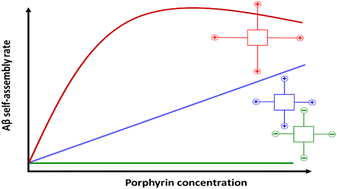
Aβ peptides self-assemble into senile plaques, a hallmark of Alzheimer's disease (AD). The search for compounds able to modulate peptide self-assembly still awaits molecular and structural insights. In the present work, we have investigated a series of cationic porphyrins. By monitoring the kinetics of peptide self-assembly using thioflavin T (ThT) fluorescence and imaging the formed assemblies by TEM and AFM, we observed the following: (i) first, some porphyrins accelerate Aβ(1–40) self-assembly to an extent that increases with the porphyrin concentration. For the others, a decrease in the kinetic rates was observed above a concentration threshold (denoted as CM) that is porphyrin-dependent. The biphasic modulation thus observed has not been reported so far in the case of porphyrins; (ii) second, the porphyrins decrease the level of Aβ(1–40) fibrils formed as their concentration increases. The interactions between the porphyrins and Aβ(1–40) were thoroughly characterized by UV-visible, NMR, and fluorescence spectroscopy techniques. The obtained data support a structure-dependent model involving π-stacking, electrostatic and hydrophobic interactions responsible for the different effects of porphyrins on Aβ(1–40) self-assembly.
 Please wait while we load your content...


