


 PLATFORM UPDATE:


Engineering dimensionality and band-edges with lone-pair cations to achieve superior X-ray detection in metal-free perovskites

Abstract
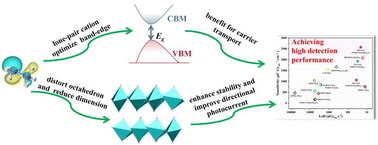
Metal-free perovskites (MFPs) have emerged as a promising class of environmentally friendly materials with exceptional optoelectronic properties, making them ideal candidates for X-ray detection and other applications. However, their development is often hindered by the trade-off between structural stability and electrical performance. In this work, we introduce a novel strategy that leverages the size effect and lone-pair electrons of the N2H5+ cation to drive dimensionality reduction and band-edge optimization in MFPs. Using DABCO-NH4(BF4)3 as a template, we successfully designed and synthesized a one-dimensional (1D) MFP, DABCO-N2H5(BF4)3, by introducing N2H5+, which induced significant octahedral distortion and facilitated the transformation from a three-dimensional (3D) structure to a 1D perovskite framework. This 1D structure enhances anisotropic charge transport and optimizes the band-edge alignment, significantly improving electrical performance, while the organic cations in the 1D structure act as physical barriers, thereby improving stability. As a result, the DABCO-N2H5(BF4)3 SC device exhibits an ultrahigh sensitivity of 2570 μC Gyair−1 cm−2 at 50 V, and an ultralow detection limit of 20.9 nGyair s−1 along the parallel direction. This work presents a new design strategy for high-performance, environmentally friendly X-ray detectors, with enhanced sensitivity, lower detection limits, and high stability under various operational conditions.
- This article is part of the themed collections: 2026 Inorganic Chemistry Frontiers HOT Articles and FOCUS: Perovskite Materials and Devices
 Please wait while we load your content...


