


 PLATFORM UPDATE:


Facile synthesis of MOF-derived Ru-doped cobalt oxide/carbon nanomaterials for electrocatalytic oxygen evolution
 *b
and
Jinjie
Qian
*a
*b
and
Jinjie
Qian
*a
Abstract
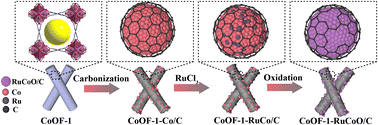
The oxygen evolution reaction (OER) poses a significant challenge in renewable energy technologies, necessitating the development of efficient and stable catalysts. Herein, a universal strategy is demonstrated that combines thermodynamically favorable ion exchange with controlled oxidation to obtain MOF-derived noble metal-doped Co3O4/C catalysts. As a model system, the as-synthesized CoOF-1-RuCoO/C preserves the nanorod morphology while promoting the dispersion of Ru species. This optimized catalyst achieves low overpotentials of 247/349 mV at current densities of 10/100 mA cm−2 in 1.0 M KOH, showing accelerated reaction kinetics compared to that of their undoped counterparts and RuO2. Meanwhile, CoOF-1-RuCoO/C shows satisfactory durability, with less than 2% activity loss after 20 hours, attributed to the protective effect of in situ formed graphitic carbons. Theoretical calculations corroborate the enhanced charge redistribution at Ru–O–Co interfaces, an elevated d-band center, and a reduced energy barrier for the key *OOH → O2 transformation. Furthermore, this combined strategy is readily applicable to various Co-MOFs (e.g., ZIF-67, MOF-274, and Co-BPDC) and noble metals (Ir and Ru) with consistent improved OER performance. These results present a platform for designing high-performance, low-loading noble-metal electrocatalysts derived from porous MOFs, exhibiting great potential to advance sustainable energy technologies.
 Please wait while we load your content...


