


 PLATFORM UPDATE:


A negative thermal quenching one-dimensional copper(i)–iodide coordination polymer scintillator: enabling high-resolution X-ray imaging
 bc
Fa-Kun
Zheng
*bc
and
bc
Fa-Kun
Zheng
*bc
and
Abstract
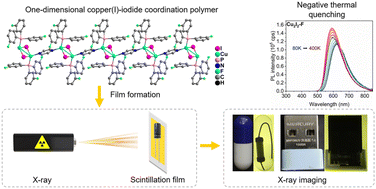
Scintillator materials typically suffer from severe thermal quenching (TQ), which limits their practical use in radiation detection and imaging. Here, we designed and synthesized a one-dimensional (1D) copper(I)–iodide coordination polymer (CP) scintillator, [Cu2I2(t3-fpp)2(pz)] (Cu2I2-F), exhibiting thermally activated delayed fluorescence (TADF) characteristics. Its small singlet–triplet energy gap (ΔEST) facilitates efficient reverse intersystem crossing (RISC), leading to pronounced negative thermal quenching (NTQ) behavior over the temperature range of 80–400 K. Under X-ray excitation, the light yield (LY) reaches 8027 photons per MeV for Cu2I2-F, comparable to that of the commercial scintillator Bi4Ge3O12 (BGO) (8000 photons per MeV). The limit of detection (LOD) is as low as 22.58 nGy s−1, well below the dose rate required for medical diagnostics (5.5 μGy s−1). The Cu2I2-F scintillation film, fabricated via drop-casting, yielded X-ray images with high spatial resolution up to 20 lp mm−1, demonstrating promising potential for applications in medical diagnostics and industrial non-destructive testing. This work not only presents a high-performance scintillator but also provides a design strategy for achieving NTQ CPs for low-dose and high-resolution X-ray imaging.
 Please wait while we load your content...


