


Reversible CO2 induced gate-opening and -closing pressures in 2D rare earth–oxalate coordination networks

Abstract
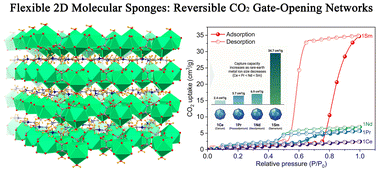
The transition from nonporous to porous states induced by gas at varying gate-opening and -closing pressures signifies a notable advancement in the development of physisorbent materials for gas sorption and separation applications. This study examines the CO2-induced gate-opening and -closing phenomena in isostructural two-dimensional (2D) rare-earth–oxalate coordination networks (CNs), (DMA)[RE(ox)2(H2O)] (1RE; RE = Ce, Pr, Nd, Sm; ox = oxalate; DMA = dimethylammonium). The sorption isotherms are modulated by pressure, temperature, and the size of the metal ions in the 2D CNs. High yields of all products in 1RE were synthesized consistently under similar solvothermal conditions, and their structures were thoroughly characterized. Structural determination revealed that the structure comprises 2D anionic layered sheets characterized by a square lattice (sql) topological network, formed through the connection of nine-coordinated {REO9} units with ox2− bidentate linkers. The aqua ligands bound to the metal centre strengthen the stability of the structures through intersheet hydrogen bonding interactions. Meanwhile the charge-balancing DMA+ cations are situated between stacked sheets and establish hydrogen bonds with aqua ligands and the oxalate linkers from the sql nets, reinforcing the stability of the structure. At 273 K and pressure up to 1 bar, the adsorption of CO2 on the thermally activated 1RE displays S-shaped isotherms with hysteresis observed in the low-pressure region. Among the materials examined, 1Sm exhibits a sudden gate-opening phenomenon after reaching a pressure of 0.78 bar (P/P0), achieving a maximum adsorption capacity of 34.7 cm3 g−1, accompanied by significant hysteresis loops roughly 0.25 bar wide and remarkable recyclability. At 77 K, the thermally activated 1Sm showed very little N2 adsorption. Additionally, the CO2 sorption isotherms for the Li+-exchange DMA+ cations of 1Sm were also investigated. This study presents a straightforward bottom-up design approach for the low-pressure gate-opening and -closing states of flexible 2D switching adsorbent materials. It further clarifies the precise and controlled fabrication of novel CO2 sorbent materials, considering the size of metal ions.
- This article is part of the themed collection: Special issue for the 10th Asian Conference on Coordination Chemistry
 Please wait while we load your content...


