


 PLATFORM UPDATE:


Bis(cyclooctadiene)nickel(0)-catalyzed exhaustive C(sp2)–X and C(sp3)–F hydrodehalogenation and deuterodefluorination of pyridines and arenes with a broad substrate scope

Abstract
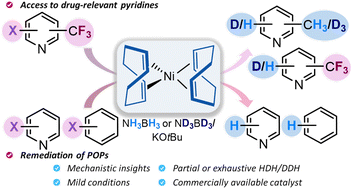
The exhaustive hydrodehalogenation (HDH) of CF3 groups in pyridines and of C(sp2)–X (X = F, Cl, Br, and I) bonds in pyridines and arenes was catalyzed by [Ni(COD)2] employing NH3BH3 in the presence of KOtBu at room temperature. The system showed a broad substrate scope, including OMe and NH2 substituted pyridines, and enabled the C(sp2)–X HDH of several environmental pollutants and the DDF of CF3 groups and C(sp2)–X bonds in pyridines, affording CD3-substituted pyridines with d incorporation at the CD3 group in >99% and high degrees of d incorporation at the ring. Mechanistic studies for the HDF of 2-trifluoromethylpyridine allowed the identification of three simultaneous HDF cycles, with the first cycle being the rate-determining and the reaction of the [Ni(COD)2] precatalyst with the H source being the entry pathway to the cycle. The key behind catalyst efficiency for exhaustive HDH and its broad substrate scope has been traced back to the use of KOtBu, which enabled hydride transfer from NH3BH3 to the [Ni(COD)2] precatalyst, rendering access to a nickelate(0) hydride complex responsible for C–F activation. Competition experiments employing pyridines allowed the rationalization of catalyst selectivity for different types of C(sp2)–X bonds and for C(sp2)–F vs. C(sp3)–F bonds, as well as the impact of the position of CF3 groups on catalyst efficiency.
 Please wait while we load your content...


