


 PLATFORM UPDATE:


Immobilization of metals on carbon nanotubes through non-covalent approaches – focus on the use of polymerized lipidic interfaces to prepare catalytic hybrids
 *a
Mateus P.
Nunes,
ab
Snehal
Pednekar,
ac
Guilherme A. M.
Jardim,
b
Eufrânio N.
da Silva Júnior,
*b
Irishi N. N.
Namboothiri
*c
and
Eric
Doris
*a
*a
Mateus P.
Nunes,
ab
Snehal
Pednekar,
ac
Guilherme A. M.
Jardim,
b
Eufrânio N.
da Silva Júnior,
*b
Irishi N. N.
Namboothiri
*c
and
Eric
Doris
*a
Abstract
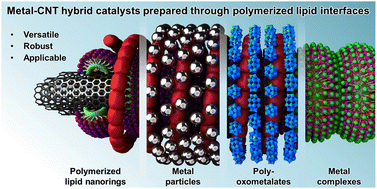
This review highlights advanced strategies for the immobilization of metal catalysts on carbon nanotubes, emphasizing non-covalent approaches and, in particular, polymerized lipidic coatings developed by our group. Such coatings provide a robust and modular interface for immobilizing catalytically active metal species, without compromising the structural and electronic integrity of the carbonaceous scaffold. Diacetylene-based amphiphiles self-assemble into hemi-micellar rings around nanotubes via hydrophobic effects and can be photopolymerized into stable structures that resist solvents, heat, and recycling. In this review, we describe how these polymerized lipid coatings serve as primary organic layers to enable dense and robust loading of catalytic metal species. The resulting nanohybrids deliver state-of-the-art catalytic metrics under exceptionally mild and sustainable conditions; for example, gold-nanotube hybrids catalyze silane oxidations at room temperature, in air, at metal loadings as low as 0.001 mol%, reaching turnover numbers up to 72 000 and turnover frequencies of 12 000 h−1, while remaining readily recyclable. By integrating nano-confined reaction environments, non-destructive carbon nanotube functionalization and layer-by-layer interfacial design, polymerized lipid nanorings emerge as a versatile platform to bridge the gap between homogeneous and heterogeneous catalysis and engineer recyclable nanotube-based catalysts for organic synthesis and energy-related applications.
- This article is part of the themed collections: 2026 Inorganic Chemistry Frontiers Review-type Articles and XXI BMIC/X BMRE/ III WTBC
 Please wait while we load your content...


