


Molecular pseudo-halogen engineering enables remarkable birefringence enhancement in hybrid perovskites
 *acde
and
Sangen
Zhao
*b
*acde
and
Sangen
Zhao
*b
Abstract
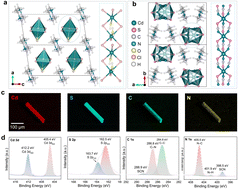
Hybrid perovskites have emerged as promising candidates for birefringent crystals due to their structural diversity. Conventional strategies to enhance birefringence often rely on incorporating highly π-conjugated organic components; however, it remains challenging to achieve both high birefringence (>0.3) and large single crystal growth. Herein, we present a pseudo-halogen engineering method that also enables giant birefringence enhancement. By substituting halogen Cl− with polar pseudo-halogen (SCN)−, we designed and synthesized a one-dimensional hybrid perovskite, namely (C6N2H15)Cd(SCN)3, which exhibits a high birefringence of Δnexp = 0.37@550 nm, more than 12 times that of isostructural (C6N2H16)Cd2Cl6·2H2O (Δnexp = 0.03@550 nm). This birefringence value not only surpasses those of all commercial birefringent crystals, but also is even higher than those of many hybrid perovskites composed of π-conjugated cations. Moreover, large single crystals of (C6N2H15)Cd(SCN)3 were readily grown by the facile evaporation method. First-principles calculations reveal that the remarkable birefringence enhancement originates from a tens-of-times increase in polarizability anisotropy of the distorted Cd(SCN)6 octahedra compared to their CdCl5·H2O counterparts. This work provides a novel molecular-level strategy towards designing high-performance birefringent crystals for polarized optics.
- This article is part of the themed collection: 2026 Inorganic Chemistry Frontiers HOT Articles
 Please wait while we load your content...


