


 PLATFORM UPDATE:


Reversible red-green photoluminescence transformation induced by dynamic coordination bonds in a phase-transition hybrid crystal

Abstract
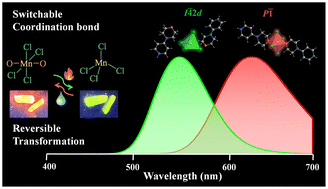
Photoluminescence (PL) switchable materials have become an important class of intelligent materials for promising applications in sensors, anti-counterfeiting and information storage. A longstanding challenge lies in the rational design of high-contrast, quick-response and reversible PL switches. Herein, we present a new organic–inorganic hybrid metal halide crystal, (C9H13N2O)2MnCl4 (1), that undergoes two-step P![[1 with combining macron]](https://www.rsc.org/images/entities/char_0031_0304.gif) (1α)-P (1TS)-I
(1α)-P (1TS)-I![[4 with combining macron]](https://www.rsc.org/images/entities/char_0034_0304.gif) 2d (1β) phase transitions at 378 K and 423 K during heating, accompanied by PL colour changes from red in 1α to orange in 1TS and green in 1β, respectively. Moreover, 1β could controllably return to 1α under different humidity conditions. Detailed structural studies reveal that the reversible transition is driven by the breaking and reformation of Mn–O bonds between C9H13N2O+ cations and Mn2+. Given the good cyclability and high sensitivity of such phase-transition-induced PL transformation, we designed different models to demonstrate the crystal's application in optical encryption. This work provides new insights for designing stimulus-responsive luminescent materials through dynamic chemical bonding for advanced optical materials with tunable and recoverable properties.
2d (1β) phase transitions at 378 K and 423 K during heating, accompanied by PL colour changes from red in 1α to orange in 1TS and green in 1β, respectively. Moreover, 1β could controllably return to 1α under different humidity conditions. Detailed structural studies reveal that the reversible transition is driven by the breaking and reformation of Mn–O bonds between C9H13N2O+ cations and Mn2+. Given the good cyclability and high sensitivity of such phase-transition-induced PL transformation, we designed different models to demonstrate the crystal's application in optical encryption. This work provides new insights for designing stimulus-responsive luminescent materials through dynamic chemical bonding for advanced optical materials with tunable and recoverable properties.
- This article is part of the themed collection: 2026 Inorganic Chemistry Frontiers HOT Articles
 Please wait while we load your content...


