


 PLATFORM UPDATE:


Multicolor and reversible stimuli-responsive luminescence of dumbbell-shaped Zn(ii) complexes with extended triphenylamine-attached ethynylpyridine terminals

Abstract
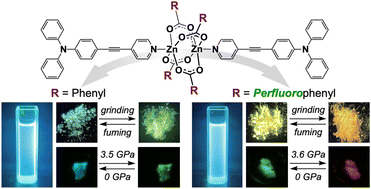
Dumbbell-shaped Zn(II) paddlewheel dimers bearing π-extended triphenylamine–ethynylpyridine ligands were synthesized to investigate how fluorination and axial π-extension influence structural flexibility and luminescence responsiveness. Single-crystal X-ray diffraction revealed that the benzoate and pentafluorobenzoate derivatives retain the Zn2(μ-carboxylate)4 core but differ in carboxylate planarity, intermolecular contacts, and overall molecular distortion. These subtle structural variations strongly affect their excited-state landscapes. The fluorinated complex exhibits an additional intramolecular charge-transfer absorption band and enhanced electronic anisotropy, leading to pronounced changes in the solid-state emission. Both complexes display reversible mechanochromic luminescence associated with partial amorphization and recrystallization, while the fluorinated derivative undergoes a larger red shift and higher quantum yield after grinding. High-pressure photoluminescence measurements on single crystals revealed continuous and nearly reversible emission shifts. The fluorinated complex shows a substantial 83 nm shift (ΔE = 0.36 eV) and a full multicolor progression from green to orange-red up to 3.6 GPa, whereas the non-fluorinated analogue displays only modest changes. These behaviors demonstrate that fluorination increases structural flexibility and enhances the pressure adaptability of the Zn2 core. The results establish a design strategy in which a d10 metal scaffold is combined with electronically tunable π-extended axial ligands to achieve multicolor, reversible, and stimuli-responsive luminescence in simple molecular assemblies.
 Please wait while we load your content...


