


 PLATFORM UPDATE:


Homoleptic biisoquinolinedioxide lanthanide complexes for near-infrared circularly polarized luminescence
 a
Ashley
Schmidt,
b
Jerome R.
Robinson,
c
Nathan D.
Schley
d
and
Gaël
Ung
*a
a
Ashley
Schmidt,
b
Jerome R.
Robinson,
c
Nathan D.
Schley
d
and
Gaël
Ung
*a
Abstract
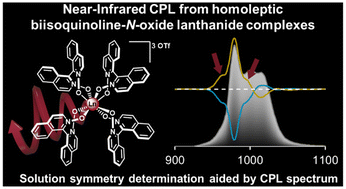
Near-infrared circularly polarized luminescence (CPL) emitters are of growing interest due to their potential applications in optical telecommunications, bioimaging, and secure information technologies. We report the synthesis and chiroptical properties of lanthanide complexes supported by axially chiral 1,1′-biisoquinoline-N,N′-dioxide ligands. 8-Coordinate homoleptic complexes composed of a 4 : 1 ligand : metal stoichiometry were obtained. Emissions in the near-infrared I and II windows (900–1700 nm) were observed for both ytterbium and erbium complexes. Although modest quantum yields (6.2% and 3.1%, respectively), and moderate circularly polarized luminescence emission metrics (glum = ±0.07 and ±0.12, respectively and BCPL = 16.1 M−1 cm−1 and 3.1 M−1 cm−1, respectively) were obtained, the polarization information contained in the CPL spectra combined with a solid-state structure allowed us to assign the symmetry of the complex in solution.
- This article is part of the themed collections: FOCUS: Rare earth luminescent materials and XXI BMIC/X BMRE/ III WTBC
 Please wait while we load your content...


