


 PLATFORM UPDATE:


Asymmetry-driven organic–inorganic hybrid strategy for constructing structures with exceptional organofunctionalized B–O units

Abstract
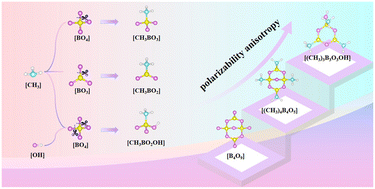
In this study, an organification-induced organic–inorganic hybrid strategy was developed to enhance the optical properties of borates. Replacing oxygen atoms in [BO3] and [BO4] with [CH3] leads to the formation of new B–O units, such as [CH3BO2], [CH3BO3] and [CH3BO2OH]. These organic-modified B–O units exhibit significantly enhanced polarizability anisotropy compared with the conventional [BO3] and [BO4]. Furthermore, these modified units assemble into two unprecedented clusters, [(CH3)4B4O5] and [(CH3)3B3O3OH]. The [(CH3)4B4O5] unit displays a larger polarizability anisotropy than [B4O9], while [(CH3)3B3O3OH] shows an even higher polarizability anisotropy than [(CH3)4B4O5]. Based on this concept, three methyl-modified borates, Rb2(CH3)4B4O5·4H2O (RCHBO), [C(NH2)3]2(CH3)4B4O5·2H2O (GCHBO) and Li(CH3)4B4O3(OH)3 (LCHBO), were rationally designed and successfully synthesized. All these compounds exhibit deep-ultraviolet (DUV) cutoff edges below 190 nm and moderate birefringence. Among them, GCHBO was successfully grown into high-quality millimeter-sized single crystals, which show a transmittance cutoff wavelength shorter than 185 nm. These findings confirm that organic-assisted hybridization is a promising route for tailoring optical properties and diversifying borate structures.
- This article is part of the themed collection: 2026 Inorganic Chemistry Frontiers HOT Articles
 Please wait while we load your content...


